


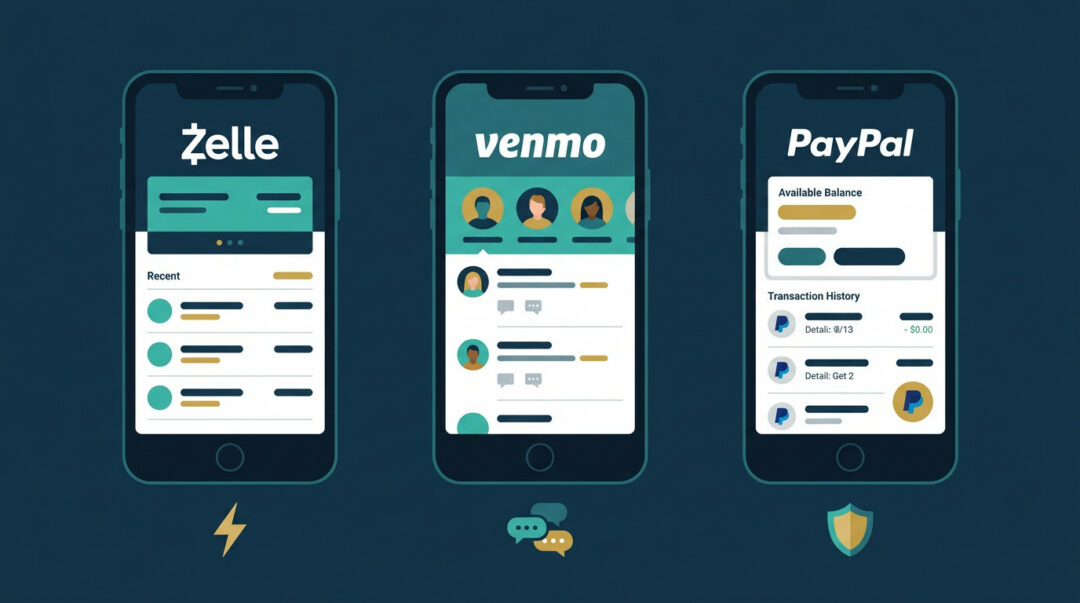
Splitting dinner, paying rent or buying from a stranger online: payment apps make it easy, but each one works differently. Fees, limits, speed and protection against scams vary. This guide compares PayPal, Zelle and Venmo so you can pick the right app for each situation.
Quick Answer
- Cheapest: Zelle is free to use, and sending from a bank account or balance on Venmo or PayPal is also free. Fees show up with credit cards, instant transfers and business payments.
- Safest for buying online: PayPal, thanks to buyer protection on eligible Goods and Services payments.
- Safest for rent and bills between people you trust: Zelle, as it moves money directly between bank accounts, but transfers are hard to reverse.
- Best for splitting costs with friends: Venmo, for its social, easy-to-use design.
PayPal vs Zelle vs Venmo at a Glance
| Feature | PayPal | Zelle | Venmo |
|---|---|---|---|
| Sending from bank or balance | Free | Free | Free |
| Credit card fee | About 2.9% + $0.30 | Not available | About 3% |
| Instant transfer to bank | About 1.75% (max $25) | Always instant, free | About 1.75% (min $0.25, max $25) |
| Standard transfer speed | 1 to 3 business days | Usually minutes | 1 to 3 business days |
| Buyer protection | Yes, on eligible purchases | No | Limited, on eligible purchases |
| International use | Yes | No (US banks) | No (US only) |
| Best for | Online shopping, freelancers, businesses | Rent, bills, trusted contacts | Splitting costs with friends |
Fees and limits can change, so check the provider’s page.
How Much Do PayPal, Zelle and Venmo Charge?
PayPal fees
Sending to friends and family from your bank account or PayPal balance is free. Paying by credit card, or receiving payment for goods and services, typically carries a fee of around 2.9% plus a fixed amount. Instant bank transfers cost about 1.75%, capped at $25. International payments add currency conversion fees.
Zelle fees
Zelle itself charges no fees. Some banks or credit unions may add their own, so check your bank. Transfers between enrolled banks arrive in minutes.
Venmo fees
Venmo is free when you fund payments from a bank account, debit card or balance. A credit card adds about 3%, and instant transfers to your bank cost about 1.75% (with a minimum of $0.25 and a maximum of $25). Business profiles pay a seller fee on sales.
What Are the Sending Limits?
- Zelle: Limits are set by your bank. Typical daily limits range from about $500 to $3,500, with monthly caps often between $15,000 and $20,000. New accounts may start lower.
- Venmo: Unverified accounts have low weekly limits, around a few hundred dollars. Verified accounts can send several thousand dollars per week.
- PayPal: Limits depend on verification and account type. Verified accounts generally get much higher limits.
Verification usually requires your name, date of birth and other identity details.
Which App Is Safest?
All three use encryption and offer two-factor authentication. The bigger risk is scams, not hacking. Remember:
- Zelle payments are sent directly to a bank account and are very hard to reverse. It has no purchase protection, so only send money to people you know and trust.
- PayPal Goods and Services offers buyer protection for eligible purchases. Paying “friends and family” removes that protection, so don’t use it for strangers.
- Venmo is built for friends. It offers protection only on certain eligible purchases. Its social feed means you should check privacy settings so your payments aren’t public.
Never send money to someone who pressures you, asks you to pay in advance or claims to be from your bank. No payment app can protect you from sending money to a scammer willingly.
Which Payment App Should You Use?
| Situation | Best choice | Why |
|---|---|---|
| Paying rent to a landlord you know | Zelle | Free, fast, direct from the bank |
| Splitting dinner with friends | Venmo | Easy, social, free |
| Buying from an online seller | PayPal Goods and Services | Buyer protection |
| Freelance or business payments | PayPal | Invoicing tools and dispute resolution |
| Sending money abroad | PayPal | Supports international payments, though fees apply |
| Paying someone you don’t know | PayPal Goods and Services | Better dispute options than Zelle or Venmo |
Tips to Stay Safe on Any Payment App
- Turn on two-factor authentication and biometric lock.
- Double-check the recipient’s name, phone number or email before you send.
- Set Venmo transactions to private.
- Use strong, unique passwords.
- Keep your bank’s fraud line handy.
- Report scams to the app and your bank right away.
Frequently Asked Questions
Is Zelle safer than Venmo?
Zelle runs through bank accounts and has bank-level login security, but it offers no purchase protection and payments are hard to reverse. Venmo has limited protection on certain purchases. For strangers, neither is ideal.
Which payment app has the lowest fees?
Zelle has no fees of its own. Venmo and PayPal are free when you pay from a bank account or balance, but charge for credit cards and instant transfers.
Can you get money back from a Zelle scam?
Often it is difficult. Contact your bank immediately, though recovery is not guaranteed, particularly if you authorized the payment.
Does PayPal charge to send money to friends?
Not when you fund it from your bank account or PayPal balance. Using a credit card adds a fee.
Can I use Venmo or Zelle for my business?
Venmo has business profiles with seller fees. Zelle can be used by some businesses through their bank. PayPal offers the most complete business tools.
Which app has the highest limit?
PayPal generally offers the highest per-transaction ceiling for verified users, while Zelle’s limits depend on your bank.
Do payment apps report to the IRS?
Payment apps may have to report certain business-type payments above set thresholds. Rules change, so check current IRS guidance or ask a tax professional.
Final Words:
Use Zelle for trusted bank-to-bank payments, Venmo for casual splits with friends and PayPal for online shopping, freelancers and anything that needs buyer protection. The safest habit is the same on all three: only send money to people you know.