The next phase of the cryptocurrency market may look very different from previous cycles.
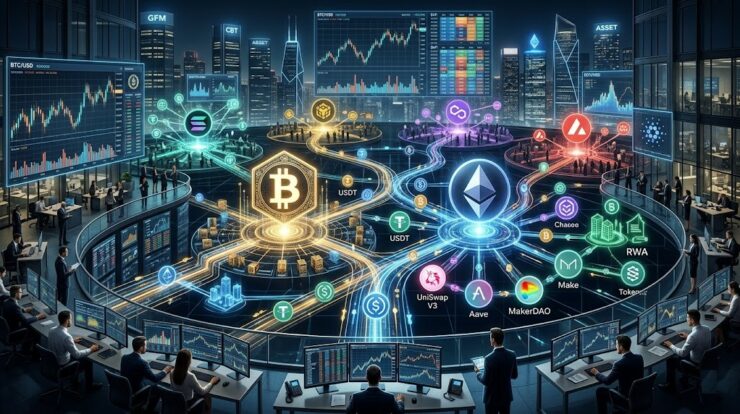
Earlier crypto rallies were often dominated by narratives surrounding Bitcoin halvings, retail speculation and rapidly rising token prices. The current market is developing around a much broader set of factors: institutional capital, stablecoins, tokenized assets, blockchain infrastructure, decentralized finance and real-world applications.
This shift raises an important question for market participants:
Is the next crypto cycle going to be driven primarily by speculation, or by actual adoption?
The answer may be a combination of both, but the balance appears to be changing.
With the total crypto market capitalization currently around $2.18 trillion and Bitcoin trading near the mid-$60,000 range, the market remains highly sensitive to liquidity and macroeconomic developments. At the same time, individual blockchain ecosystems are showing very different levels of activity.
From Token Prices to Blockchain Economics
One of the biggest changes in crypto is the growing importance of network economics.
A blockchain can no longer be judged simply by asking how much its native token has appreciated.
Investors are increasingly examining transaction activity, stablecoin liquidity, application revenue, developer participation and institutional adoption.
This is particularly relevant because two networks can have similar market capitalizations while serving completely different economic purposes.
Bitcoin is primarily viewed as a scarce digital asset and monetary network.
Ethereum functions as programmable settlement infrastructure.
Solana is positioning itself around high-performance applications and on-chain markets.
BNB Chain focuses heavily on accessible decentralized applications.
XRP Ledger is associated more closely with payments and financial settlement.
Understanding these differences can provide a much clearer picture of where the market is heading.
Liquidity Will Remain One of the Most Important Factors
Crypto markets are highly dependent on liquidity.
When liquidity increases, risk appetite can expand quickly. Capital can move from Bitcoin into Ethereum, from Ethereum into Layer-1 networks and eventually into smaller assets.
When liquidity contracts, the reverse can happen just as quickly.
This explains why macroeconomic conditions remain extremely important for digital assets.
Interest-rate expectations, inflation data, central-bank policy and global financial conditions can influence how much capital investors are willing to allocate toward higher-risk assets.
For this reason, crypto investors should not analyze blockchain activity in isolation.
A strong blockchain ecosystem can continue to develop even during a weak market, but token prices may still struggle when overall liquidity is falling.
Bitcoin’s Role in the Next Cycle
Bitcoin is likely to remain the starting point for most institutional crypto exposure.
Its market size, liquidity and established reputation make it easier for large investors to access than smaller digital assets.
The current market also shows that institutional investors are becoming more disciplined.
Coinbase’s 2026 institutional survey found that 49% of surveyed institutions had increased their focus on risk management, liquidity and position sizing, even though 74% expected crypto prices to rise over the following 12 months.
That combination is significant.
Institutional investors may remain bullish on digital assets while simultaneously becoming more selective about which assets they own.
This could make the next cycle more focused on quality rather than simply chasing every available token.
Ethereum and the Rise of On-Chain Finance
Ethereum remains central to the development of on-chain finance.
The network supports a large ecosystem of decentralized exchanges, lending markets, stablecoins, tokenized assets and Layer-2 networks.
Its stablecoin position is particularly important.
Fidelity Digital Assets reported that Ethereum hosted approximately $164 billion in stablecoin supply at the end of March 2026 and remained the dominant blockchain for stablecoin issuance and settlement.
This gives Ethereum a significant structural advantage.
Stablecoins create liquidity.
Liquidity attracts applications.
Applications attract users.
Users generate transactions.
Transactions can then attract additional developers and capital.
This creates a network effect that can be difficult for competitors to reproduce.
Solana and the Competition for On-Chain Activity
Solana represents perhaps the clearest example of a network challenging Ethereum through a different technical and economic model.
Its focus on high transaction throughput and low costs has allowed it to build significant activity in decentralized trading and other on-chain markets.
Galaxy Research reported that Solana processed approximately $650 billion in stablecoin transaction volume during February 2026, while stablecoin market capitalization on the network reached $15.45 billion in Q1.
The more interesting development, however, is the expansion beyond speculative trading.
Tokenized assets, stablecoins and financial applications are becoming increasingly important parts of Solana’s ecosystem.
This creates a potentially powerful narrative for the network: instead of depending entirely on speculative activity, Solana can attempt to build a broader financial infrastructure.
The Rise of Tokenized Real-World Assets
Tokenization could become one of the defining themes of the next crypto cycle.
The basic idea is straightforward: traditional assets such as equities, bonds, funds or other financial instruments can be represented as digital tokens on blockchain networks.
The potential benefits include faster settlement, programmable ownership, global accessibility and improved transparency.
Several blockchain ecosystems are competing for this market.
Ethereum has the advantage of established institutional infrastructure and deep liquidity.
Solana is attracting attention through high-performance trading and tokenized asset activity.
Other networks are also developing specialized infrastructure for financial institutions.
The winner may not necessarily be the blockchain with the lowest fees. Institutions may prioritize security, compliance, liquidity, custody and interoperability just as much as speed.
Stablecoins Could Be the Real Infrastructure Story
There is a strong possibility that stablecoins will become one of the most important blockchain applications of the decade.
Unlike many crypto assets, stablecoins solve a practical problem: transferring digital value without exposing users to the extreme volatility of assets such as Bitcoin or Ether.
They can be used for cross-border payments, settlement, trading, payroll, remittances and decentralized financial applications.
Coinbase’s 2026 outlook describes stablecoins and payments as a major crypto use case and expects expansion into cross-border transactions, remittances and payroll platforms.
The broader institutional market is also increasingly treating stablecoins as financial infrastructure rather than simply crypto trading instruments.
This could have major implications for blockchain competition.
If stablecoins become widely used for payments, the networks that can provide reliable, inexpensive and scalable settlement may capture a significant share of future digital financial activity.
Why Layer-2 Networks Matter
Ethereum’s Layer-2 ecosystem could also play an important role in the next market cycle.
Layer-2 networks allow applications to process transactions away from Ethereum’s main execution layer while maintaining a connection to Ethereum’s underlying security and settlement environment.
This can reduce costs and improve scalability.
But it also creates a complicated economic relationship.
If users increasingly interact with Layer-2 networks, investors may ask whether value accrues primarily to Ethereum or to the individual Layer-2 ecosystems.
This is one of the most important unanswered questions in the Ethereum investment thesis.
The answer may depend on how settlement demand, fees, applications and liquidity evolve over time.
BNB Chain, XRP Ledger and the Multi-Chain Future
The future blockchain economy is unlikely to be dominated by only two or three networks.
BNB Chain remains important because of its large user base, accessible transaction environment and application ecosystem.
XRP Ledger has a different proposition, focusing more heavily on payments and financial transfers.
Other networks are also developing specialized solutions for gaming, decentralized infrastructure, privacy, data and tokenized assets.
This suggests that the future could be increasingly multi-chain.
Rather than one blockchain replacing every competitor, different networks may specialize in different economic activities.
That would make interoperability increasingly important.
What Could Drive the Next Major Market Move?
There are several factors worth monitoring.
Institutional Allocation
Large investors could provide significant demand for major cryptocurrencies, particularly Bitcoin and Ethereum. However, institutional investors are becoming more selective and risk-conscious.
Stablecoin Growth
Rising stablecoin supply can indicate increasing liquidity and activity within blockchain markets.
On-Chain User Activity
A rise in active users and transaction activity can provide stronger evidence of adoption than token prices alone.
DeFi Liquidity
Decentralized lending and trading activity can reveal whether capital is actually being deployed on-chain.
Tokenized Assets
Growth in tokenized equities, funds and other real-world assets could create a new source of blockchain demand.
Regulation
Clearer regulatory frameworks can make it easier for financial institutions and businesses to participate in digital assets.
The Biggest Risk: Growth Without Sustainable Demand
There is also an important warning.
Not every increase in blockchain activity represents long-term adoption.
Markets can experience temporary spikes caused by speculation, incentives, leverage or short-term narratives.
For this reason, investors should distinguish between activity and sustainable demand.
A healthy ecosystem should ideally show multiple forms of usage: users, developers, stablecoins, applications, liquidity and recurring economic activity.
If one metric grows while the others remain weak, the underlying expansion may be less durable.
What the Next Crypto Cycle Could Look Like
The next crypto cycle may be more selective than previous ones.
Bitcoin could remain the primary institutional asset.
Ethereum could continue to function as a major settlement layer for stablecoins, DeFi and tokenized assets.
Solana could continue challenging established networks by attracting trading, stablecoins and high-performance applications.
BNB Chain and other Layer-1 ecosystems could capture users through specialized applications and low-cost infrastructure.
Meanwhile, Layer-2 networks could transform Ethereum into a broader network of interconnected execution environments.
The most interesting part is that these trends do not necessarily conflict with each other.
Crypto adoption could expand enough for several ecosystems to grow simultaneously.
Conclusion
The cryptocurrency market is entering a phase where infrastructure may matter more than hype.
The next major opportunity may not come from discovering another token that suddenly increases in value. Instead, it could come from identifying the networks that become essential infrastructure for payments, trading, decentralized finance, tokenized assets and institutional settlement.
Bitcoin remains the market’s most important benchmark, but the broader ecosystem is becoming increasingly diverse.
Ethereum’s stablecoin and DeFi dominance, Solana’s high-performance ecosystem, BNB Chain’s accessibility and XRP Ledger’s payment focus demonstrate how different blockchain models can coexist.
For market participants, the key lesson is simple:
Watch where the users and liquidity are going—not just where the prices are moving.
That distinction could prove increasingly valuable as crypto evolves from a speculative asset class into a broader digital financial infrastructure.
This article is for informational and educational purposes only and should not be considered financial or investment advice.