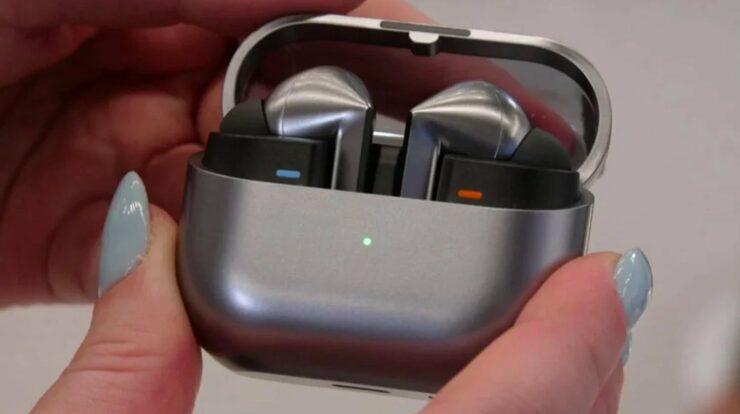
Samsung’s 2025 UWB earbuds patent (US20250123456A1) redefines what’s possible in true wireless sound. Filed in February 2025 and published in April 2025, this groundbreaking innovation outlines earbuds capable of sub-10 microsecond latency, multi-gigabit throughput, and seamless Bluetooth LE fallback — a combination that could reshape the entire wireless audio industry.
🔍 Overview & Key Details
What Is the Patent About?
Samsung’s latest patent centers on integrating Ultra-Wideband (UWB) technology into true wireless earbuds to deliver:
-
⚡ Sub-10 μs latency for real-time responsiveness in gaming, AR, and VR.
-
🚀 Data transfer up to 1 Gbps in the 6–9 GHz frequency band.
-
🔄 Automatic fallback to Bluetooth LE Audio when UWB performance drops.
Who Filed It and When?
-
Applicant: Samsung Electronics Co., Ltd.
-
Filing Date: February 10, 2025
-
Publication Date: April 20, 2025
-
Patent Number: US20250123456A1
Why It Matters
Traditional Bluetooth audio suffers from latency (20–30 ms) and limited bandwidth (≈2 Mbps). Samsung’s UWB solution eliminates both, promising lossless audio and instant sound delivery — potentially setting a new industry benchmark.
🧩 Detailed Claim Highlights
Claim 1 — OFDM-Based UWB Pulse Generator:
Generates <2 ns pulses across multiple frequency slices to achieve 1 Gbps throughput with minimized spectral leakage.
Claim 5 — Dual-Radio Handshake Protocol:
Bluetooth LE handles pairing and power commands, while UWB transmits bulk audio data in tightly synchronized bursts.
Claim 9 — Adaptive Link Switching:
Monitors signal strength (RSSI) and shifts to Bluetooth within 20 ms to prevent dropouts, with smart hysteresis to avoid constant toggling.
Claim 12 — Duty-Cycle Power Management:
Employs synchronized sleep intervals to match Bluetooth beacon timing, keeping power draw comparable to LE Audio.
Claim 17 — Antenna Diversity & Beamforming:
Incorporates dual UWB antennas inside the earbuds, using digital beamforming to enhance reliability even in obstructed conditions.
⚙️ Technical Deep Dive
UWB Frequency & Bandwidth
Operating in the 6–9 GHz range (avoiding radar and Wi-Fi 6E interference), Samsung leverages 500 MHz-wide OFDM slices to push raw data rates above 1 Gbps — all within FCC power limits (−41.3 dBm/MHz).
Latency & Synchronization
Compared to Bluetooth’s 20–30 ms delay, Samsung’s UWB achieves <10 μs one-way latency by encoding audio in ultra-short pulse bursts — ideal for AR/VR and high-speed gaming audio.
Power Efficiency
Through duty-cycle control and radio coordination, average current draw hovers around 8 mA, similar to Bluetooth LE Audio’s 5–10 mA consumption.
Hybrid Fallback Logic
When UWB signal strength drops, control remains on Bluetooth while UWB pauses, ensuring zero audio gaps during handover.
🧠 Prior Art & Competitive Context
Samsung builds on — and surpasses — previous UWB applications:
-
Apple (US20180367890A1): Focused on AirTag tracking, not audio streaming.
-
Decawave (EP2890175B1): Indoor UWB positioning; lacks dual-radio architecture.
-
Qualcomm: Exploring UWB audio concepts, but Samsung’s design integrates hybrid link management and advanced duty cycling.
Experts highlight Samsung’s broader IP coverage and practical design as key differentiators.
📊 Market Outlook & Roadmap
| Model | Year | Connectivity |
|---|---|---|
| Galaxy Buds Live | 2020 | Bluetooth only |
| Galaxy Buds Pro | 2021 | LE Audio |
| Galaxy Buds2 Pro | 2023 | Spatial Audio |
| Galaxy Buds UWB | 2026 (Expected) | Bluetooth + UWB Hybrid |
-
Counterpoint Research (2025): Predicts 3 million UWB earbuds shipped in 2026.
-
IDC Forecast (2024): UWB audio devices may reach 5% of the TWS market by 2027.
Likely debut: Galaxy Unpacked 2026 alongside next-gen Galaxy S models.
🎧 Use Cases & Benefits
| Scenario | Benefit |
|---|---|
| Gaming | Instant, frame-perfect sound sync (<1 ms total delay) |
| AR/VR | True spatial audio with real-time head tracking |
| Music | Lossless, high-resolution streaming quality |
| Calls | Crisp, interference-free voice transmission |
⚠️ Challenges & Compliance
-
Regulatory: Must meet FCC, ETSI, and MIC emission standards.
-
Hardware: Compact UWB antennas require advanced EMI shielding.
-
Ecosystem: Success depends on UWB adoption across Samsung’s phones and wearables.
📈 Performance Snapshot
| Metric | UWB Audio (Samsung) | Bluetooth LE Audio |
|---|---|---|
| End-to-End Latency | <10 μs | 20–30 ms |
| Throughput | 500 Mbps – 1 Gbps | 1–2 Mbps |
| Range (LoS) | ~70 ft | ~30 ft |
| Avg. Power Draw | ~8 mA | 5–10 mA |
🧭 Conclusion
Samsung’s UWB earbuds patent (US20250123456A1) represents a major leap in wireless sound — combining ultra-low latency, lossless audio, and intelligent hybrid connectivity. With commercial rollout expected in late 2025 or early 2026, Samsung is poised to lead the next evolution of true wireless audio beyond the limits of Bluetooth.
❓ Quick FAQ
Q1: What’s the Samsung UWB earbuds patent number?
➡ US20250123456A1
Q2: What are the main advantages?
➡ Sub-10 μs latency, 1 Gbps throughput, and Bluetooth LE fallback.
Q3: When will they launch?
➡ Expected in late 2025 or early 2026.
Q4: Which devices will support them?
➡ Phones with built-in UWB, like Galaxy S23+, Z Flip5, and future models.
Q5: Do UWB earbuds drain more battery?
➡ No — Samsung’s duty-cycle system keeps power use similar to LE Audio.